
Safety Signage: Types, Uses and Best Practices for Workplaces

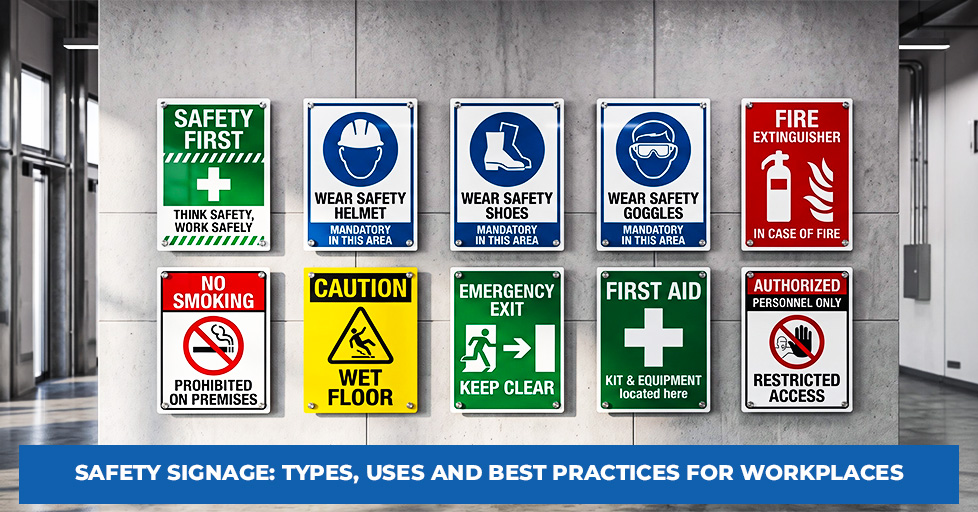
Most of us only notice safety signage when something is wrong with it. A fire exit sign hidden behind a stack of cartons. A “wet floor” board that has stood in the same corner for two years. A danger notice in English on a shop floor where half the team reads Tamil or Kannada.
None of these looks serious on its own. But these small gaps are how a minor slip becomes a proper accident. A good safety sign board does one simple thing: it tells the right person the right thing at the right moment. This post covers the safety signs most workplaces need, where people tend to go wrong, and what to look for when you hire someone to do the job.
Why Safety Signs Still Matter
Training and rules matter, of course. But people forget, contractors come and go, visitors wander in, and new joiners spend their first week unsure which door leads where. Workplace safety signs cover all of that without anyone having to say a word.
There is the compliance side too. Factory inspectors, fire auditors and insurance surveyors walk around checking the basics: marked exits, extinguisher points, electrical warnings, PPE notices. Missing signs are easy for them to flag and easy for you to fix beforehand.
And clients notice. When a customer visits your plant and sees tidy, consistent safety sign boards throughout, they form their own opinion about how the place is run.
Types of Safety Signs for Workplaces
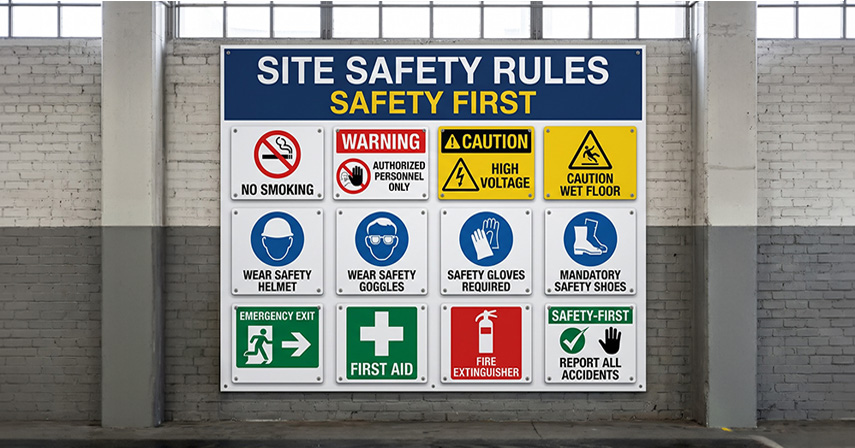
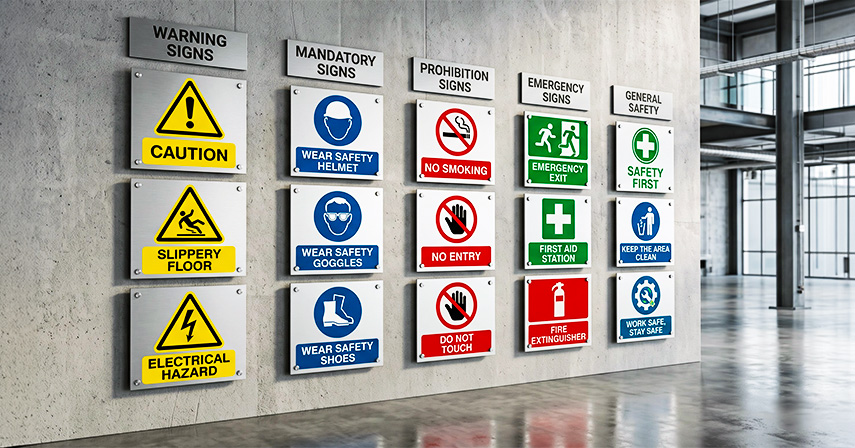
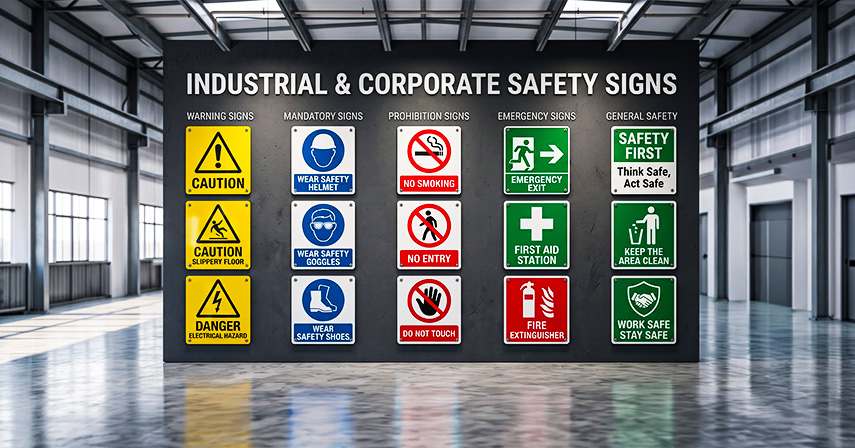
The categories are simple once you see them side by side.
Mandatory Safety Signs are blue with a white symbol, and they tell people what they have to do: wear a helmet, use safety shoes, put on ear protection. Put them at the entrance of the area where the rule applies, not only at the main gate where nobody reads them.
Prohibition Safety Signs are the red circle with a diagonal line. They cover no smoking, no entry, no mobile phones, no naked flames. Place them where the behaviour actually happens. A no-smoking sign by the canteen back door does more than ten at reception.
Warning signs, caution signs and danger signs get mixed up all the time. Safety warning signs point to a hazard that can hurt someone. Warning and danger classifications can vary depending on the safety standard being followed. The important point is to use consistent, recognised symbols and wording appropriate to the level of risk.
Fire Safety Signs mark extinguishers, hose reels, alarm points, fire doors and assembly areas. Walk your corridor once and check whether you can see the next one from where you stand. If you can’t, neither can anyone else smoke.
Emergency Exit and Evacuation Signs include the green running-man boards, arrows along passages and floor plans with a “you are here” marker. Photoluminescent versions are worth the extra cost because they keep glowing during a power cut, which is exactly when people need them. Together with extinguisher and first aid boards, these make up your emergency safety signs.
Safety Instruction Signs belong on panels, transformers, DG rooms and cable trenches. “Danger 440V”, “Authorised persons only”, “Do not switch on”. These tend to get skimped on, and they shouldn’t.
Then there are safety information signs and safety instruction signs, which show first aid points, emergency numbers, safe lifting steps or machine operating rules. Many plants also put up safety notice boards and safety display boards near the gate or canteen for toolbox talk points, accident-free day counts and near-miss reports.
Industrial Sites Are Hard on Signs
If you have been inside a foundry, a paint shop or a cold storage unit, you know the problem. Heat, dust, oil, moisture and chemical splashes wear down cheap signs quickly. Industrial safety signs that peel or fade within six months create a false sense of cover, because the wall looks handled when nobody can read the board anymore.
So material matters. Acrylic, aluminium composite, reflective sheeting or etched metal each suit different spots. Printing and finishing matter too, and so does mounting height. A sign fixed too high, or behind a pipe, may as well not exist. Good safety signage solutions begin with the environment, not a catalogue.
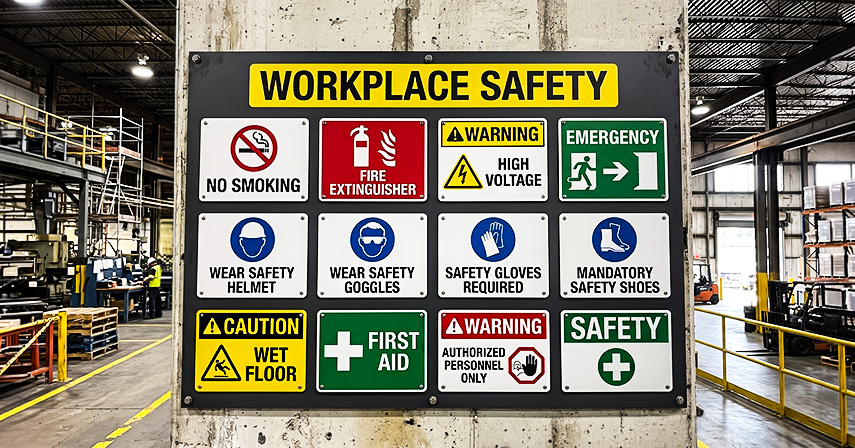
What to Look for in a Safety Signage Company
Plenty of shops can print a board. Far fewer will walk your site, tell you what is missing, design a matching set, make it and fit it properly. You want that whole chain with one team, because when design, production, and installation sit with different vendors, mistakes fall between them and nobody owns the fix.
ARC India works this way. The team has more than 15 years in the business, and the projects range from a single factory floor to dozens of branches at once. A few things about how they operate:
- In-house Manufacturing: Everything is made at their own facility. If a size needs changing or the Hindi wording needs correcting, it doesn’t have to go back through an outside printer.
- End-to-end Service: Design, manufacturing, and installation sit under one roof, with one point of contact and one timeline.
- B2B Experience: Business clients care about consistency across branches, paperwork, delivery schedules, and signs that hold up in an audit. That is a different job from supplying one board to a shop owner.
- A Proper Design Team: They think about contrast, symbol clarity, font size, reading distance, and lighting at the spot where the sign will hang.
- Corporate Branding: Safety colours and symbols stay standard, but borders, typefaces, and layouts can follow your brand guidelines, so the signage looks like it belongs to your company.
- A Trained Installation Crew: Fixing method, height, sightlines, and clean-up are handled by people who follow the site plan rather than guessing on the day.
- Multi-Location Execution: For companies with several plants or branches, production and dispatch are coordinated so every site ends up at the same standard.
Multilingual Safety Signage for Mixed Workforces
Language is where many sites slip up. Across South India, one shift can include people who read Kannada, Tamil, Telugu, Malayalam, Hindi, and English. A sign that works for only one group isn’t doing its job.
The team handles multi-language signage installation in Kannada, Tamil, English, Telugu, Malayalam, and Hindi. Translation quality matters here. Word-for-word translations often read strangely, so someone fluent should check the final text. Pairing words with a clear pictogram helps as well, since the symbol still works for a person who can’t read the script.
Safety Signage Services Across Bangalore, Chennai and Other Cities
ARC India serves all industries across the main industrial and commercial centres of the region:
- Bangalore: IT parks, aerospace and machine shops, large commercial towers. Installation is available across the whole city, from Whitefield and Electronic City to Peenya and Hebbal.
- Chennai: automobile, engineering, electronics and port-linked logistics. City-wide installation covers areas like Ambattur, Guindy, Sriperumbudur and OMR.
- Coimbatore: textile mills, pump makers, foundries and engineering units, where machinery and electrical hazards are part of daily life.
- Mysore: manufacturing, food processing, education and hospitality.
- Hosur: a busy industrial town on the Tamil Nadu and Karnataka border, heavy on automotive and electronics.
- Tumakuru: a fast-growing industrial belt with new factories, warehouses and infrastructure projects.
The industries involved include manufacturing (factories making goods), logistics and warehousing (storing and moving goods), healthcare (hospitals and clinics), IT and corporate offices, education, hospitality, construction and real estate, and power and utilities. Each has different risks, so the sign plan differs too. A hospital needs clear evacuation routes and easy-to-read boards, while a chemical plant needs hazard and PPE signs at every process area.
Safety Signage Checklist Before You Order
A few simple steps can save you money and rework:
- Walk the site first. Look at entrances, stairs, machine zones, storage rooms and exits.
- Stick to standard colours: red for prohibition and fire, yellow for caution, green for safe conditions and exits, blue for mandatory action.
- Think about where each sign will hang and what it will face every day.
- Check language and reading distance.
- Ask who will install it, and whether they have handled a site of your size before.
Final Thoughts
Safety signage is one of the cheapest ways to reduce workplace risk. It guides people, warns them, reminds them, and in an emergency helps them get out. What separates effective signs from signs that just hang on a wall is the thinking behind them: the right message, the right material, the right spot.
If you are setting up a new facility, auditing an old one, or rolling out one standard across several branches, work with a team that can take you from first sketch to final fitting. ARC India has the experience, the manufacturing setup, and the installation crews to do that across Bangalore, Chennai, Coimbatore, Mysore, Hosur, and Tumakuru. Reach out, tell them about your site, and start with a walk-through.
What are the most common types of safety signs in a workplace?
Mandatory, prohibition, warning, caution, danger, fire safety, emergency exit, electrical and general information signs. Most sites need a mix of all of them.
How often should safety signs be replaced?
There is no fixed date. Check them at least twice a year, and replace anything faded, damaged, blocked by new equipment, or no longer matching the hazard in that area. Outdoor and harsh industrial zones usually need replacing sooner.
What is the difference between a warning sign and a danger sign?
A warning sign flags a hazard that could cause harm if ignored. A danger sign is for the most serious, immediate risks, like live high-voltage equipment.
Can safety signs be made in more than one language?
Yes. Our Signage can be made in Kannada, Tamil, English, Telugu, Malayalam, and Hindi, often with pictograms alongside. This works well on sites with a mixed workforce.
Can you handle signage for several branches or plants?
Yes. A multi-location job is planned as one project, with the same design, materials, and installation standard at every site, whether they sit in one city or several.
Do safety signs have to match our company branding?
The safety colours and symbols stay standard, but layout, fonts, borders and supporting elements can reflect your brand.