
Why Every Growing Company Needs a Great Employee Welcome Kit And How to Get It Right

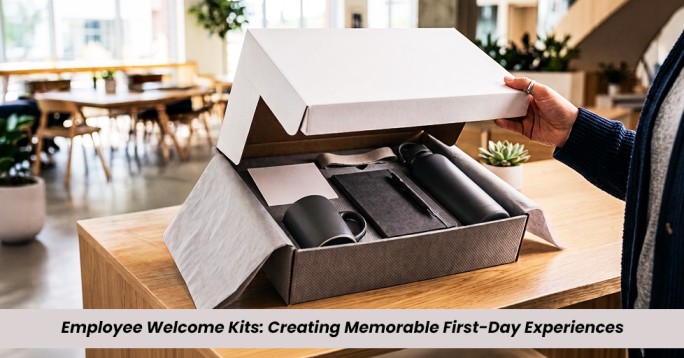
A new hire walks into the office on day one. Nervous, a little excited, noticing everything. What’s sitting on their desk in that first hour tells them more about your company than any onboarding deck ever will. That’s the whole reason welcome kits have gone from a nice little extra to one of the most talked-about pieces of modern HR strategy.
If you run people operations, talent acquisition, or workplace admin, you already know hiring is only half the job. Retention starts the moment an offer letter is signed, and it either accelerates or stalls depending on how the first day feels. A well-planned corporate welcome kit does more than hand someone a laptop and an ID card. It sets the tone for their entire time at the company, long before their first project even starts.
What Is an Employee Welcome Kit?
Strip away the branding language and it’s simple: a curated box handed to an employee on or before their start date. Some HR teams call it a joining kit, others say new hire kit or employee joining kit. It usually includes branded merchandise, essential paperwork, stationery, and a few extras that quietly say, “we planned for you before you even walked through the door.”
Naming conventions differ from company to company. Some prefer employee kits, others just say office welcome kits. It doesn’t really matter what it’s called. The intent stays the same: make new employees feel like they belong immediately, not like outsiders slowly finding their footing over the first few weeks.
Why B2B Companies Are Investing Heavily in This Right Now
For years, this was treated as a startup thing, something only quirky, ping-pong-table companies bothered with. That’s changed fast, and it’s become one of the more visible HR trends in 2026 as companies fight harder than ever to hold on to good people. Established, process-driven organizations now track onboarding as a measurable part of the retention funnel, right alongside compensation benchmarking and career-path planning.
A few things are driving this shift.
First, early impressions genuinely affect attrition. Employees who feel disconnected during their first ninety days are far more likely to leave within the year. A thoughtful new hire welcome kit closes that gap almost instantly, giving people something real to associate with belonging from day one.
Second, hybrid work quietly killed off the onboarding rituals that used to just happen on their own. When everyone sat in the same office, company culture spread through overheard conversations and shared lunches. With teams scattered across cities now, a well-packed new hire welcome package shipped straight to someone’s home has become the stand-in for that in-person warmth.
Third, branding starts from the inside these days. Companies pour money into shaping how the outside world sees them, yet employees remain the most credible ambassadors any brand has. A polished company welcome kit reinforces that identity from within, and it’s exactly the kind of detail new hires bring up later on review sites or in casual conversation with friends.
What Should Actually Go Into a Welcome Package
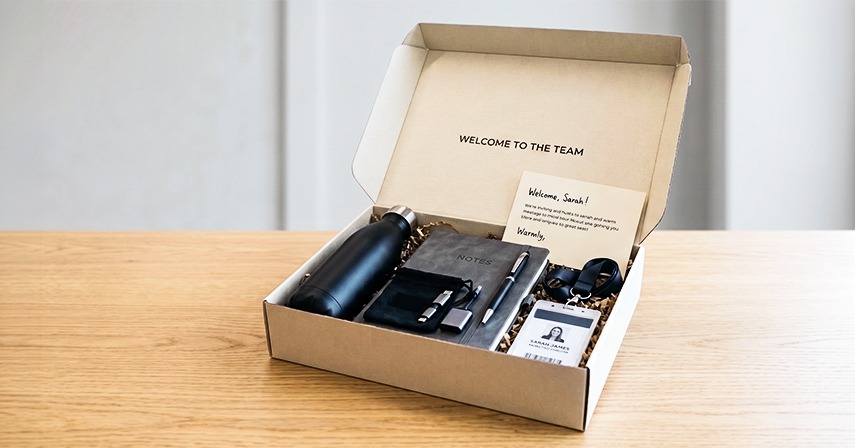
There’s no fixed formula, but the best welcome pack ideas for new employees usually balance function with warmth. A few things that consistently work:
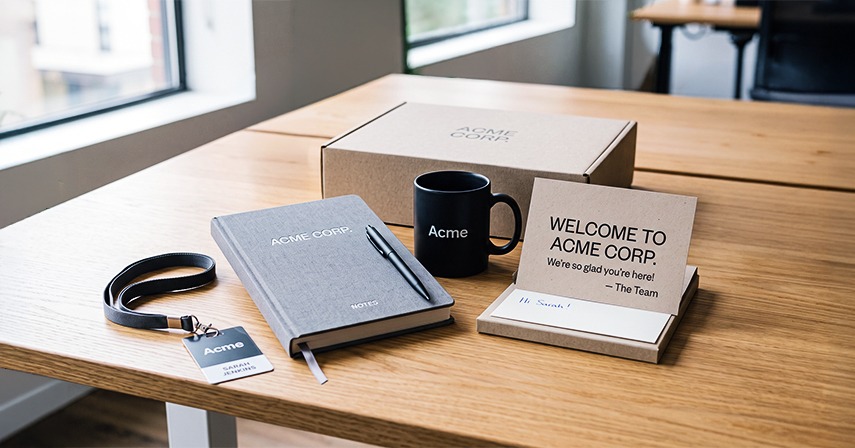
- Branded essentials – notebooks, pens, a water bottle, maybe a laptop sleeve in company colors.
- A short, personal note from the manager or a senior leader, handwritten if possible.
- Merchandise people will genuinely use, not shelve and forget.
- Paperwork bundled cleanly – ID card, policy documents, IT access – A short culture booklet in plain language, no corporate jargon.
- One small local or seasonal touch tied to the city or festival calendar, which is the kind of detail generic kits always miss.
The point of a good company welcome pack is never to bury someone in merchandise. It’s to communicate care through small, deliberate choices a new employee notices without anyone having to point them out.
Scaling This Across a Growing Workforce
Here’s where things get operationally messy. Putting together a joining kit for employees is easy enough when you’re hiring five people a quarter and packing boxes on a spare desk. It turns into a real logistical headache once HR is onboarding hundreds a month, across cities, departments, and seniority levels, all against start dates that simply cannot slip.
This is exactly the gap ARC India was built to close. As companies scale their hiring pipelines, they need a partner who can produce consistent, high-quality employee welcome kits at volume without losing the personal touch that makes the whole thing worth doing. Whether it’s a small batch of joining kits for a handful of lateral hires or thousands of units for a campus drive, the process has to hold up at either end of that scale.
What genuinely separates a reliable production partner from an average one is large in-house production capacity. Instead of farming out printing, packaging, and merchandise sourcing to a scattered mix of third parties and hoping the timelines line up, having it all under one roof means faster turnaround, tighter quality control, and fewer last-minute surprises when a hiring cohort suddenly doubles in size.
Why Location Actually Matters for Delivery
For companies based in South India, proximity to production changes almost everything about onboarding logistics. A partner with a real presence across prime business districts in Bangalore and Chennai means shorter delivery windows, easier last-minute changes, and the ability to absorb urgent bulk orders. When hiring spikes without warning, which happens to nearly every fast-growing tech, services, or manufacturing company at some point every year.
ARC India’s footprint across both cities means HR teams skip the usual back-and-forth with vendors sitting far away, cutting cost, delivery risk, and the low-grade anxiety of a shipment running late right before a big joining batch. For enterprises with offices spread across both hubs and beyond, this kind of local presence often ends up being the deciding factor in who gets picked as a long-term onboarding partner.
Choosing the Right Partner for Your Onboarding Kits
Sourcing a solid welcome kit for new employees at scale means thinking past a single hiring cycle. A vendor that performs well on a small order of new hire kits doesn’t always hold up once volumes climb or timelines get tight, which is why long-term partnerships tend to beat ad-hoc sourcing almost every time.
A few questions worth asking before signing anyone on:
- Can they absorb sudden spikes in hiring volume without missing deadlines?
- Is production genuinely in-house, or does the order quietly pass through several subcontractors along the way?
- Can they customize contents by department, seniority, or region without stretching out lead times?
- Do they have a real track record with companies your size, in your industry?
- Can they actually deliver, on time, in the specific cities where your offices sit?
ARC India is built around these requirements, pairing production scale with real regional delivery strength for organizations that can’t afford onboarding delays during a critical hiring push.
Final Thoughts
A well-executed welcome package isn’t a line item tucked away in the HR budget. It’s a real extension of employer branding and retention strategy. Whether a company calls it a corporate kit, an office package, or just a joining box, the goal never changes: make new employees feel like they belong from the moment they arrive.
As hiring volumes climb and hybrid work keeps reshaping how teams connect, a consistent, well-produced employee onboarding kit program isn’t optional anymore for companies serious about culture and long-term retention. The organizations getting this right are the ones treating onboarding with the same seriousness they bring to any other brand touchpoint, and it shows up both in employee satisfaction scores and in how new hires talk about their first week to friends, family, and future candidates
Why should a welcome kit and a joining kit be necessary for corporate gifting?
An employee welcome kit helps new hires feel valued from their very first day. Nowadays it is mandatory, and it’s been used for appreciation, and presenting them with it boosts company value.
What should a new hire welcome kit include at a minimum?
While you are having a welcome kit, the box can include custom t-shirts, custom coffee mugs, printed custom diaries, bottles, and custom pens. So packed with all the custom products that each corporate house prefers to have.
How far in advance should welcome kits be delivered?
For remote or hybrid hires, most companies aim to have the kit arrive two to three days before the start date, so it’s waiting for them rather than arriving mid-week. For in-office hires, kits are typically kept ready at the desk on morning one.
Can welcome kits be customized by department or seniority level?
Yes, and this is increasingly standard for mid-size to large enterprises. Leadership hires often get a more premium kit, while bulk entry-level or campus hires get a simplified, cost-efficient version. A good production partner should be able to handle both without slowing down delivery.
Is it cheaper to produce welcome kits in-house or outsource them?
For low volumes, in-house assembly can work fine. Once a company crosses a certain hiring volume, though, outsourcing to a partner with large in-house production capacity almost always works out cheaper and faster, since it removes the coordination overhead of managing multiple vendors for printing, packaging, and merchandise separately.